KMT Flogs Horse: Beast Still Dead

In the movie The Dead Zone, Christopher Walken’s character Johnny Smith is gifted (or cursed) with the power to see the future, which he accidentally uses to discover that a senatorial candidate will one day become a Hitler-like president of America.  After some moral searching, Johnny assassinates the candidate before he can unleash nuclear Armageddon.

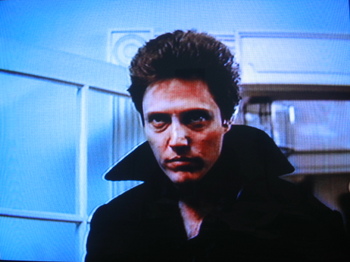
Christopher Walken in The Dead Zone

Of course, the moral equation would be pretty easy to solve if someone happened to have completely reliable powers of precognition*.  But what if Johnny’s precognitive powers were accurate only 80% of the time?  How about 50%?  Ten?  Would assassination still be justifiable?  And suppose Johnny was just a jobless, clinically-depressed nutcase, over-reacting to outrageous political hyperbole, something along the lines of this?

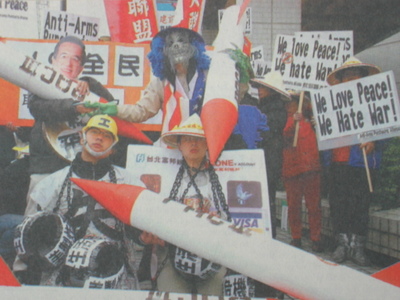
Yes, that’s right.  That’s a KMT rally, with an effigy demonizing Taiwan’s president by dressing him in Nazi garb.  So, when a political party likens the country’s president to Hitler and Osama bin Laden, and one of its less stable followers goes over the edge because he fails to realize that you really meant that in a GOOD WAY, who ya gonna blame?

Why the victim, of course!  The president must have faked his own shooting!

One of the big tragedies here is that they never took the assassin alive.  Instead, when he realized that police had found the black market dealer who sold him the weapon, he destroyed much of the evidence and committed suicide.  The police did manage to wiretap the family afterwards however, and when confronted with some of their incriminating conversations, they decided to ‘fess up.

That was about a year ago.  The March 13th edition of the Taiwan News had an update in a story entitled "Shooter’s wife says ‘coerced’ to tell the truth" (Sorry, I can’t find the link).  A couple of days ago, the KMT was to hold a big, expensive rally against the abolition of the National Unification Council, and discovered that a lot of people just couldn’t muster much outrage over the abolition of a council with a $30 a year budget which hadn’t met in ten years.  Lo and behold, the wife of the assassin came forward just in time for the Chen hate-fest to recant her confession, informing the press that, ahem:

…it was not until some "nice people" presented her family with evidence that her husband had been framed that her family started to realize that the investigation closed last August was all about "judicial persecution" and was nothing short of a "savage act" against their human rights.

So the KMT Big Lie about the "stolen presidential election" is about to be told again.  And again.  What I AM curious to know is exactly what "evidence" the "nice people" happened to give her.  It wouldn’t by chance have been presented in a big, ol’ red envelope**, would it?

For more on this, I would recommend Michael Turton’s The View from Taiwan, which covers it very well.  It even has comparison photos of the now-deceased perpetrator alongside security camera shots, which should convince all but the most dyed-in-the-wool grassy knoll conspiracy geeks that the police fingered the right man.  Plenty of links, too.

One final note:  the daughter of the assassin points to the surveillance camera recording of the perpetrator, and claims that her father is innocent:

"[The man in the tape is bald.***]  My father was not bald…he just had a high forehead."

Boy, if I had a nickel every time I heard my old man say THAT…


* We can wonder whether Johnny didn’t have other options open to him for stopping the candidate from becoming president, short of assassination.  However, for the purposes of a Stephen King thriller, it might have been less than dramatically satisfying if the protagonist had merely founded a Stop Stillson! grassroots political organization.

** In Taiwan, gifts of money are customarily placed inside red envelopes.

*** Closer inspection of the grainy security camera pictures provided at The View from Taiwan seem to suggest that the perpetrator was not in fact bald, but that his hair was reflecting light from the sun.  Click the link and judge for yourself, though.


UPDATE (Mar 15/06):  A commenter raised a couple great points that merit repeating:

…did you notice the contradiction in this statement:

"…it was not until some "nice people" presented her family with evidence that her husband had been framed that her family started to realize that the investigation closed last August was all about "judicial persecution" and was nothing short of a "savage act" against their human rights."

The contradiction, of course, is that she couldn’t have been "coerced" if she didn’t realize that she was being persecuted until later. What’s more, why did the family burn both the suicide notes that didn’t look like suicide notes and the yellow jacket (that didn’t look like the yellow jacket shown in the video)? This evidence, afterall, helps the family (if they are telling the truth). (emphasis added)


i-1

Whistling In The Dark

Every time I see Dr. Joe Hung’s photo in the commentary section of the China Post, I can’t help but smile.  He looks like a kindly old grandpa, and I’m sure that in person he’s a lovely man.  So perhaps it’s his kindly nature that motivates him to write nonsense like this:

China does not have to launch any propaganda campaign to tell the world its rise is peaceful. All historians know China, after its invasion of Korea in the second century before Christ, has never tried to expand by force except the brief period in which it was ruled by the Mongols. The invasion of Korea was ordered by the Emperor Wu Ti of the Han Dynasty before he finally made Confucianism the state cult. Cheng Ho visited Southeast Asia and part of Africa, but none of the territories he visited were colonized, albeit Ming China, at the height of a dynastic cycle and with Lady Luck smiling on it, could have easily expanded its empire.

No one should be afraid of an expansionist jingoist China. Not even Taiwan. There will be no Chinese invasion, so long as Taipei refrains from declaring independence for Taiwan. (emphasis added)

QED.  And for the Doctor’s next trick, maybe he can scour the historical records to somehow "prove" that the Red Guards won’t wreck China’s historical treasures or the Khmer Rouge won’t empty out the cities.  Heck, if he’s right about the past being 100% predictive of the future, you can throw away your smoke detector or the lock on your door and it won’t make one bit of difference.  Better still, SELL them and blow your windfall on something you like – a trip to the movies, or maybe some chocolate.  You’ve never had your house burn down or be burglarized before, so what on earth makes you think it’ll happen in the future?

In fact, the China Post has, in the past, made precisely that argument regarding Taiwan’s defense needs.  Appease China by not declaring independence and Taiwan won’t NEED any weapons.  Then Taiwan can take all the money it saves on useless armaments and spend it all on the political equivalent of chocolate: social programs.

Mmmm.  Social programs.  Politicians love ’em.  Give enough of ’em to the voters, and they’ll forgive you almost anything.

To be fair though, the folks at the China Post has been inconsistent in making this argument, so it looks like not even THEY fully believe it.  As for Dr. Hung, well, he kind of contradicts some of his own rhetoric:

Without the luck of a Godsend support from the United States after the Korean War in 1945 (sic), Mao Zedong could have easily "washed Taiwan with blood."

China wanted to wash Taiwan in blood?  And you’re telling me it’s peaceful?  Hoo boy, you’ve got me convinced!

Now, I don’t have a PhD in Chinese history like Dr. Hung does, and I’ll be the first to admit that he knows far more Chinese history than I EVER will.  But it seems to me that in his paragraph-long summary of Chinese history, he’s neglected to mention a few things – events that happened not within the Han or the Sung or the Ming Dynasties, but within the last 60 years.  And these things are not particularly supportive of his thesis.

First, there’s the inconvenient matter of the invasion of Tibet.  Then, there’s the war with Taiwan.  Next, the one with South Korea, America and the UN.

But don’t stop me, ’cause I’m on a roll here.  Does Dr. Hung forget China’s border clashes with Russia?  With India?  With Vietnam?

Forgive me if I’ve missed any.  Like I said, I’m no expert.

Somehow, the fact that "peaceful" China has fought virtually every single one of its neighbors within a span of a mere 60 years managed to slip Dr. Hung’s mind.  Or, is it that none of these really count, because China was somehow "provoked" into it – each and every time?

How fortunate then, that China wound up with atheistic communism as its political ideology.  Who needs the Buddhist mantra, "Om mani padme om," when, "The other guy made me do it," is so much more useful in justifying a gunfight?

(It’s not quite as poetic, I’ll grant you, but maybe it sounds better in the original Mandarin.)

Dr. Hung’s vision is a beautiful one, and I certainly hope he’s right.  Like I said earlier, he looks like he’s a perfectly decent man.  It’s just that one of the problems with decent men is that they’re sometimes willing to give the benefit of the doubt to those who are decidedly unworthy of it.  Since we’re talking history, I’ll close with a little quote from the Melian Dialogues in Thucydides’ History of the Peloponnesian War.  It reflects a more sober, more tragic, and I fear, more real view of human nature:

"Of the gods we believe, and of men we know; that by a necessity of their nature, they rule as far as their nature permits."

The translation’s a little rough to navigate.  Essentially it means that people are liable to use the power that lies at their disposal.  Unfortunately, the aphorism provides no exceptions; not even for "peaceful" countries which expand their military 15% a year while furiously building blue-water navies and maintaining 2.3 million man armies.


UPDATE (Mar 15/06):  Recall the China Post‘s arguments that Taiwan doesn’t need arms, and can safely spend the money on social programs instead.  Today’s China Post and Taiwan News both had pics of an anti-American weapons sales protest by a couple of dozen outside the American quasi-embassy in Taiwan.  This photo’s from the Taiwan News. (Sorry, no link available):

Capitulationist, pro-Communist Taiwanese  protesting against weapons for Taiwan

To call them ‘capitulationists’ almost seems too kind.


i-1

And I, For One, Welcome Our New Insect Overlords

The Foreigner loves niche marketing.  Want an A&W Root Beer or a ginger beer in Taiwan?  Good luck finding them – unless you go to Jason’s Supermarket in the basement of Taipei 101.  Dittos for fresh Thai galangal, lemongrass or kaffir lime leaves.  Incredibly, I hear they even have beets there.  I’ve NEVER seen beets in a supermarket here before.  Ever.  Might just have to pick some up and make me some borscht.

So I’m pleased to see that the China Post has decided to cater to a long-neglected political niche in Taiwan: the pro-invasion faction.

Foreigner, that’s hyperbole, you say. 

Alright, judge for yourself.

President Chen recently announced that the enactment of Beijing’s Anti-Secession Law last year would be henceforth be commemorated each March 14th as "Anti-Aggression Day*".  Now, I’m not sure if there’s anything particularly controversial about saying, "I’m in favor of not being invaded."  I would think that it would be kind of like saying that you’re in favor of motherhood and apple pie.  But leave it to the good ol’ China Post to come out against it:

The administration of President Chen Shui-bian on Wednesday took yet another move to vent its feelings of hatred and opposition to Beijing by designating March 14 as an "Anti-Aggression Day," to be marked annually beginning from this year.

Come on, Chen, in the immortal words of Jon Stewart: "Don’t be an invader hater".  On an important anniversary such as this, you should let bygones be bygones.  Have you considered sending Hu Jintao an FTD® Thanks a Bunch® Bouquet?

The China Post then wrings its hands over the possible outcome:

If anything, the action may only further provoke a Beijing already angered by Chen’s recent abandonment of Taipei’s long-established unification policy.

Stop it right there, Chen!  Saying you DON’T WANT China to invade is probably the surest way of MAKING them invade.  Try using a little reverse psychology.  Why don’t you offer China Taiwan’s full and unconditional surrender and see how that works, instead?

Chen:  (slowly) Reverse psychology, eh?  (boldly) Hu Jintao, I hereby offer you Taiwan’s full and unconditional surrender!

Hu Jintao:  I accept.

Chen: D’oh!

Speaking of trustworthy communists:

…as stipulated in the same law, Beijing wants to peacefully co-exist with Taiwan and, moreover, is very much willing to improve bilateral relations. That is to say, Taiwan can continue to maintain its democratic system and freedoms so long as its political leaders do not make radical moves to provoke Beijing.

Your freedoms are great, says Beijing.  Unless we happen to object to any of them.  Then we’ll peacefully co-exist with you with a very large boot up your butt.

Is this for real?  Did someone in Taiwan actually write this, or did the Capitulation Post just print this verbatim from a recent CCP Propaganda Ministry fax?

That will have to remain a riddle wrapped in a mystery inside an enigma, for they close with a prediction:

In the year ahead and beyond, the top politicians of the ruling party are likely to hold many more anti-China activities.

Could be, could be – if you consider the declaration of an "Anti-Aggression Day" to be an "anti-China activity".  Here then, is a little prediction of my own:  in the year ahead, the China Post and the pro-communist KMT party are likely to engage in more pro-invasion activities while obsequiously serving their masters in Beijing as communist apologists.  They will also resolutely obstruct more weapons appropriations bills for Taiwan – because after all, the defense of Taiwan is ultimately nothing more than an "anti-China activity".

And in all of this, I wish them luck.  After all, in a truly democratic society, why should the one to two percent of the population who favor an attack by a foreign power** be left without anyone in the public arena to voice their fondest dreams and aspirations? 


* "Anti-Aggression Day" is meant to be one of those rip-off holidays which is special enough to have its own name, but isn’t quite special enough that you can actually take the day off.

** A poll conducted some time ago revealed that 5% of the Taiwanese public favors a Chinese invasion.  My guess is that the actual number is more like 1-2%, based on the assumption that half of the respondents were either pulling the pollsters’ legs…or stoned utterly out of their minds.

A Horse Is A Horse, Of Course, Of Course

President Lincoln used to ask a riddle:  if you call a tail a leg, how many legs does a dog have?  He enjoyed revealing that the answer was four…because CALLING a tail a leg didn’t MAKE it one.*

By the same token, the Japanese Foreign Minister decided that calling Taiwan a province of China didn’t actually make it one, and said so in public.  Said the FM:

"[Taiwan’s] democracy is considerably matured and liberal economics is deeply ingrained, so it is a law-abiding country.  In various ways it is a country that shares a sense of values with Japan."

Whoa!  The KMT and Taiwan’s other capitulationist parties aren’t going to like hearing THAT.  For them, the single country in the world most worthy of praise and emulation is CHINA.  In response to the Japanese minister, we might soon hear some more Japan-bashing from KMT head Hizoner Ma Ying-jeou.  Perhaps something similar to his previously stated desire for a "battle to force a settlement" with Japan over the disposition of the Senkakus Islands.

Shortly after the Japanese Foreign Minister’s statement, China engaged in a little flipfloppery.  It was not so long ago – barely a week, in fact – when they called upon the United Nations to spank Taiwan for abolishing the National Unification Council.  Interfere in our internal affairs all you like, they told the UN at the time.**

But when the Chinese Foreign Minister heard that his Japanese counterpart had called Taiwan a "country", he got all prickly, angrily responding, "We are strongly protesting against this rude intervention in China’s internal affairs."

Aw, c’mon guys.  You’re either in favor of foreign interference in your "internal affairs" or you’re against it.  What’s it gonna be?

Interestingly, The China Post had a few more statements from the Japanese FM illustrating the growing resentment the Japanese feel due to China’s bullying:

[The minister likened] Japan to a rich but physically weak child who is picked on at school.

"What do you do so you don’t get bullied? There is no other way than to run away or fight," Aso told supporters last weekend in the central city of Kanazawa, the magazine said.

"You may be able to graduate from school in three years. But when it comes to countries, neighbors will be neighbors forever," it quoted him as saying.

Perhaps then, calling Taiwan a country is a demonstration of Japan’s increasing unwillingness to play the 98 pound weakling in the schoolyard.  I can’t help but think that Japan was once a Great Power, and that if it wanted to, it could be again.  It may be most unwise to push around the Japanese.


* Of course, the children’s story, "The Emperor’s New Clothes" makes essentially the same point that the truth is the truth.

There is however, a countervailing Chinese story that states the truth is whatever the powerful happen to say it is.  In this story, a Chinese emperor sees a mule, calls it a horse in front of his court, and then asks the courtiers what kind of an animal they think it is.  Those who answer truthfully are beheaded on the spot for having the effrontery to publicly disagree with the emperor.

(Similarly, Winston Smith in 1984 is told that the Party has new answers for simple arithmetic questions, and is tortured when he gives the "wrong" answers.  After sufficient "re-education", he accepts that the Party is always right about such things.)

**  Someone at the National Review or the Weekly Standard asked a question relating to China’s request to the UN to upbraid Taiwan "province" for abolishing the NUC.  When was the last time, the writer asked, when President Bush went to the UN to call for help in dealing with a troublesome American state governor?

Diplomatic Leverage

Having failed to enlist America in its attempts to stop Taiwan from abolishing a council with a $30 a year annual budget, China yesterday desperately appealed to the mighty UN for help from this insidious threat to its very existence:

Watch your step, Taiwan!  Maybe we’ll expel you from the Security Council!

(Sorry fellas.  Already been done.)

OK then, maybe we’ll just have to reject your bid for a seat in the General Assembly!

(Nope, won’t work either.  That happens EVERY year.)

Uhhh, suppose we COULD put your World Health Organization application on the back burner…

(Pfft.  Like it was ever on the fast track?)

OK, think, people, think!  Abolishing councils that’ve been defunct for seven years is almost as serious as the publication of cartoons, and we all know what Kofi thought about THAT.  Taiwan simply must be made to face the music!

(Freedom’s just another word for nothin’ left to lose…)

How Do They Get Away With That, Anyway?

Taiwan’s decision to abolish the National Unification Council (NUC) and National Unification Guidelines (NUG) has set China into a full rage spin control, with China declaring to any and all who will listen that Chen’s move is a provocation which will lead to destabilizing tensions between the two countries.  It’s a terrific act, but a single paragraph in the Taiwan News put the whole thing into perspective:

In fact, Beijing was once critical of the NUG and NUC, pointing to them as major obstacles to China’s unification with Taiwan, and as efforts by Taiwan to push for its memberships in international organizations as an independent political entity, Chang said.

That’s hilarious!  You see how this works?  China said that ESTABLISHING the council in 1990 was a provocation.  And abolishing it in 2006?  Well, that was a provocation, too!  My, my, those Taiwanese certainly ARE troublemakers.  Why are they always picking on poor, peaceful little China like that?

Exactly WHERE is the mainstream media on this, that’s what I want to know.  Journalists usually love to juxtapose politicians’ current stands with old quotes that they’ve managed to dig up.  Reporters relish watching a pol squirm as he tries to weasel out of what he’s said before.  A quick LexisNexis search here, and they’d be in business.  Are they simply too lazy to do one, or are transparently flimsy pretexts somehow deserving of a special pass?

(Double thank-you’s to Michael Turton for first spotting the quote, and then for fixing the story link.)


UPDATE (Mar 4/06):  In criticizing the press, I neglected to mention the Taiwanese government.  They’ve known that Chen was thinking about getting rid of the NUC for the last month now, so why didn’t they have musty old copies of The New York Times ready on hand to show foreign governments?  They could have pre-empted China’s "provocation" guff early on, or else presented those old quotes immediately afterwards in order to make Beijing look foolish.

God, that would have been beautiful.

Wile E. Coyote vs. President Chen

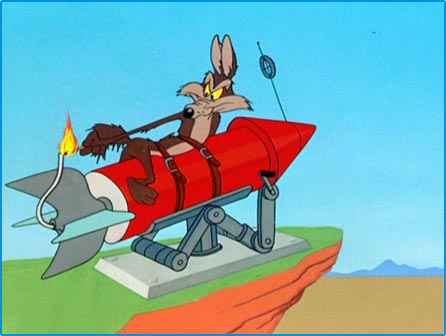
Taking a page from the clever coyote, Taiwan’s KMT and other capitulationist parties have dusted off their Acme™ Impeachment Rocket©, and taken careful aim at President Chen.

Wile E. Coyote lighting rocket he is strapped to

His crime?

Illegally wiretapping the political opposition?  Lying to a grand jury?  Making an illegal $1.88 billion stock sale through a dummy investment corporation?

No, no, much worse than any of that.

He abolished a council with a thirty dollar a year budget that hasn’t convened in seven years.

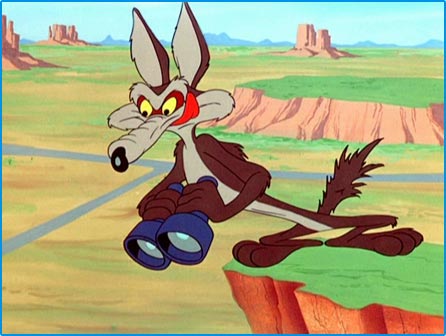
And so, in spite of The China Post‘s sober words of caution*, Chen’s ever-shrewd opponents press ahead in the certainty that impeaching him over this unpardonable enormity will be a permanent stain on his record, an embarrassment which’ll forever render him a laughingstock.  The coyote, having lost his mind along with his sense of proportion, rubs his hands together in eager anticipation as the roadrunner comes into view…

Wile E. Coyote licking lips on top of a cliff while holding binoculars

Please call me when it’s over.  At age FIVE I knew how it would end.


* It is in no spirit of mockery that I describe The China Post‘s editorial, "Impeachment could bring instability" as containing "sober words of caution".  While the paper’s editorial board obviously loathes Chen, here’s one of their thoughts that neutral observers would likely agree with:

"…we should avoid taking extreme measures [ie: recall or impeachment] that could promote instability and wreak havoc on our system of constitutional government."


i-2

Feb 28. On The Other Hand…

A day after writing my post February 28, it dawned on me that there was another way of thinking about The China Post‘s editorial on Taiwan’s infamous February 28 Massacre which was was a bit more sympathetic.  My earlier post was predicated on the assumption that The China Post is a KMT newspaper.  However, if one supposes that it’s actually a mainlander paper, then one can view what they wrote in rather different terms.

To start with, a quick background:

The population of Taiwan is composed of four major groups: Hoklos, Hakkas, mainlanders and aborigines.  About 70% of the population are Hoklo – descendants of southern Chinese who migrated to Taiwan four or five hundred years ago.  The feelings that this group has towards China are ambivalent, sometimes hostile.  Another 10% are Hakkas, who arrived from the mainland about three or four hundred years ago.  Roughly 20% are "mainlanders" – immigrants from China (or their descendants) who arrived in Taiwan after the KMT was defeated on the mainland.  And finally, about 2% are aborigines related to Pacific Islanders.  Numerically, economically and politically, aborigines are the least influential of the four groups.

With that explained, it is now possible to view the February 28 Massacre through two different lenses.  On the one hand, it can be seen as a political conflict between the KMT party and the native Taiwanese.  But on the other, it can be interpreted as an ethnic conflict between Hoklos and mainlanders.

The dangerous thing about thinking about 228 as an ethnic conflict is that doing so threatens to create rancor among ethnic groups, and may make future inter-ethnic conflict more likely.  That of course is in no ones interest, least of all minority mainlanders.  Wide-scale bitterness towards a political party can always be remedied by closing up shop or by the party renaming itself, which is what communist parties in the Eastern Bloc did after 1989.  But your ethnicity is your ethnicity until the day you die.  Hence The China Post‘s perfectly valid desire, as a mainlander paper, to ease hostility towards mainlanders.

Of course, The China Post is both a KMT AND a mainlander paper, so the analyses in BOTH this post and the previous post are partly true.  My chief objection to The China Post‘s editorial was its suggestion that the Taiwanese should not only bury the hatchet, but sweep all their questions under the rug as well.  It seems to me that if I were a mainlander, I wouldn’t want people to stop asking questions about the 228 Massacre.  Instead, I would want to do all that I could to direct the blame away from mainlanders per se and onto the KMT of old, along with its former leader, now long dead.

But because The China Post is also a KMT newspaper, this is something we will never see.

February 28

It’s not just a date in Taiwan, but a national holiday.  The day commemorates the 1947 massacre of 27,000 Taiwanese by KMT troops from China, which followed a failed revolt instigated by the KMT’s rapacious occupational policies.  It’s always an uncomfortable time for the capitulationist KMT party, which still wields considerable influence in Taiwan and indeed holds a majority in the Taiwanese legislature.

Interesting then, how the English-language pro-KMT China Post tries to paper over the massacre:

As a matter of fact, it is not important to find out the chief culprit. He may be Gen. Chen Yi, the administrator-general of Taiwan from 1945 to 1947. He may be Keh Ching-en, Chen’s chief of staff. He may be Maj. Gen. Liu Yu-ching, the commander of an infantry division sent to Taiwan from China to "suppress" what was considered a rebellion. He may be Chiang Kai-shek, the head of state, as [a new] special report charges. The fact is that they are all dead, and it’s of no practical use to blame any of them, unless the writers of the [latest] report and the man who commissioned it had some ulterior motive.

Just who exactly does the China Post think they’re kidding?  Of course it matters whether Chiang Kai Shek, former dictator of Taiwan, was responsible for the February 28 Massacre.  It matters a great deal whether Chiang Kai Shek was a decent leader who simply made an error in judgement in appointing a bad governor to administer Taiwan, or whether he was chief architect of an atrocity.  If the former is true, then he deserves our sympathy.  If the latter, his portrait should immediately be removed from Taiwan’s currency, public schools and government offices.  Mass murderers do not merit statues in public places, nor should roads or buildings be named in their honor.  There is no Adolf Hitler International Airport in Germany, for obvious reasons.  (And let me be clear: Chiang Kai Shek was no Hitler, but 27,000 people winding up murdered isn’t small potatoes, either.)  If the Generalissimo was behind the massacre, then I can’t for the life of me see why there should still be a Chiang Kai Shek International Airport.

The China Post‘s editorial goes on:

The [new] report is supposed to be a result of historical research. The writers are all historians, one of whom heads the Academia Historica. It seems that they forget what history is. History is understanding. History is a dialogue between the past and the present. History does not pass judgment. History is what notable events historians record just as Leopold von Ranke says "wie eigentlich gewesen (as is truly seen)."

What blather is this?  "History does not pass judgement"?  Of course it does!  It’s history’s job to tell us who’s responsible for what.  What did Nixon know, and when did he know it?  Some historian somewhere positively SALIVATES over the possibility that he’ll be the one who finds the memo that definitively answers that question.  Regarding the matter of World War I, historians initially assigned the lion’s share of the blame to the Central Powers.  Twenty or thirty years later, revisionist historians found evidence that the war wasn’t caused by evil intent, but by a series of misunderstandings and tragic blunders.  And about twenty years after that, the counter-revisionists found new evidence that once more pointed to prior German militarism as the war’s prime motivator.

And so it goes.  Future evidence will be found to strengthen the claims of one side or another, for the study of history never ends.  But the China Post‘s point that history is "a dialogue between past and present" eludes me.  Yes, history can speak to me, at least in a metaphorical sense.  And yes, people of today can ask questions about the past that perhaps never occurred to those who came before us.  But precisely how does claiming that history is a dialogue between past and present invalidate the latest study regarding Chiang Kai Shek’s culpability?

If anything, this claim is an unintended DEFENSE of the motives of the authors of the study.  For it is THEY who are engaged in dialogue with the past, asking tough questions – questions that were forbidden during the dark days under dictatorship.

There is then the obligatory attack on Taiwanese President Chen Shway-bian:

President Chen Shui-bian spoke at a meeting to mark the publication of the special report. He cited Chiang Kai-shek as the chief culprit. Is he one of those few people wishing to know who masterminded the massacre? Is it part of his hate-China campaign?

First, the China Post implies that few Taiwanese are interested in knowing the truth regarding the massacre.  I have no reason to know whether this is true or not.  But even if it is, how does it invalidate the question?  Discovery of the truth, like discovery in general, is always pioneered by the few.  Galileo was one of "those few wishing to know" about the heliocentric solar system.  Why should scorn be heaped upon Galileo for wanting to know what most others were too busy or uninterested in learning?

The statement about Chen hating China is one of the reasons why I’ve avoided using the term, "pro-China" to describe the KMT and its political allies.  For if one faction is pro-, then it’s natural for most to assume that the other side must be anti-.  At that point, it’s too easy to characterize the "anti-China" parties as haters.

But seekers of Taiwanese independence are not necessarily China haters, any more so than young adults moving away from home are haters of their parents.  It’s possible to like China (or ones parents) without wanting to live under the same roof as them.

The China Post feels that the next point is important, for it’s mentioned in Joe Hung’s column as well:

The people of Taiwan are not hateful people. Nor are they vengeful people. They know hatred makes everybody unhappy.

It’s indeed proper to point out that the Taiwanese people have not been hateful or vengeful, and have not visited revenge upon Chiang Kai Shek’s descendants.  For Taiwan’s former dictator has been dead many years, and whatever his responsibility for the 228 Massacre was, his grandchildren are blameless of the crime.*

But the implication here is not that the Taiwanese should be congratulated for the extraordinary decency they’ve shown to the Chiang family, but that those asking questions should be condemned for bringing up painful periods of history.  Let sleeping dogs lie; don’t threaten the peace of Taiwan.  Murderers of 27,000 people mustn’t be blamed, for blame is something to be reserved for those who ENQUIRE about the guilt or innocence of historical figures.

Finally, the China Post closes with a plea for forgiveness:

In fact, they believe the feud between islanders and mainlanders that the February 28 Incident begot was disarmed when President Lee Teng-hui proclaimed Peace Memorial Day in 1998. He apologized for the massacre on behalf of his Kuomintang government.

The massacre should not be condoned, but what is needed is forgiveness, which does not seem to be included in the dictionary of President Chen and those who wanted to publish the special report.

A few points here.  As a pro-KMT paper, it’s in the China Post‘s interest to argue in favor of forgiveness for the KMT.  Let’s face it:  it’s a tough job politically to get people’s votes after you’ve massacred their grandparents.  People don’t usually forget little things like that.

This doesn’t mean that the China Post is necessarily wrong in asking people to move on; it just means that they’re not a disinterested party in the discussion.  At the same time though, one should note that the China Post has no trouble demanding additional Japanese apologies for World War II, yet reflexively shrinks from calling for KMT apologies for the 228 Massacre.  Former KMT leader Lee Teng-hui (whom the China Post openly despises) apologized ONCE they say, and that ought to be good enough for everybody**.

One last point, a point about forgiveness.  Christians might read and be sympathetic to the China Post‘s calls for forgiveness, because it’s what their religion instructs them to do.  Sometimes I get the sense that in America this is given a bit too freely, as illustrated by the parents of a school shooting victim I once saw on TV, who tearfully stated in front of the camera that they didn’t hate the perpetrator, and that they forgave him.

That interview was conducted on the same day their son was murdered.

The same freakin’ day.  I’m sorry, that’s not godly; that’s downright creepy.

I’ve since become slightly familiar with the Jewish attitude towards forgiveness, which is a little more grudging than that of Christians.  Jews too, believe that forgiveness is an imperative, but that the perpetrator must first apologize, and then promise not to repeat the transgression.  Only then, can they ask forgiveness from the victim.  At that point, only the victim – not his friends, not his family, not even God Himself – can grant that forgiveness.

It logically follows from this that murder is perhaps the one truly unforgivable sin. 

Why?

It is unforgivable because only the victim can grant forgiveness.  But once murdered, the victim is NO LONGER ALIVE to offer that forgiveness. 

Agree with that approach or not, it’s something to think about the next time some huckster comes by opportunistically demanding from you forgiveness on the cheap.


* The Chiang family may be blameless for the crimes of Chiang Kai Shek, but they are not above using the force of the law to bludgeon those who would learn the truth.  The editorial also states that John Chiang has mounted a lawsuit against academics who would dare to look at the historical record and suggest that his grandfather may have fallen somewhere short of sainthood.  Perhaps Mr. Chiang should be reminded that the study of history should be conducted using reason, research and argumentation, rather than bailiffs, judges and 154 million dollar libel suits.

** This brings to mind a Finnish joke I once read in Ann Landers or Dear Abby.  A woman asks her husband of twenty years why he never says, "I love you."  The man replies, "I told you that the day we were married.  Why should I have to repeat myself?"


UPDATE (Mar 4/06):  The Taipei Times had an account the February 28 commemmoration, along with KMT chairman Ma Ying-jeou’s appearance at same:

Ma, who spoke in broken Hoklo, was heckled by the audience…

He spoke in Hoklo (the native Taiwanese language), rather than Mandarin?  Wonder how his Hoklo compares to the pandas?

OK, cheap shot.  Anyways, the hecklers called the capitulationist chairman a "slave of China", and shouted, "Long live the Republic of Taiwan."

As Rodney Dangerfield used to say, "Tough crowd, tough crowd."
Anachronisms and the Sixth Branch

By now, you’ve probably heard of the president of Taiwan’s decision to abolish the National Unification Council.  I say "abolish" because there was a bit of translational hair-splitting on CNN International last night as to whether it was "abolished", or whether it now merely "ceases to apply".

The CNN anchorman seemed a bit hysterical, demanding to know how Chen could be so "reckless" as to abolish the NUC, after China had warned that doing so would cause wars, floods, plagues, and all of those other things that they usually say will happen whenever Taiwan dares to undertake democratic reforms.  One should be aware that had Taiwan caved into China’s belligerent threats in the past, it would not now have direct presidential elections, a president from outside the House of Chiang, or a national referendum law (limited though it may be).

In the course of the discussion, CNN did admit that the council responsible for the tempest hadn’t actually MET in 7 years, but strangely neglected to mention that it had an operating budget of a whopping thirty dollars per YEAR.  Perhaps they wanted to spare the viewer of the burden of deciding for themselves whether the reaction was just a little over the top.  If so, then this would not be the first time it had done so.

(A side note here:  am I the only one who finds it a bit rich to hear China crying "Provocation!" over the abolition of a defunct $30 a year council when it adds million dollar missiles WEEKLY to its arsenal targetting Taiwan?)

At any rate, the question of what a country ought to do with its moribund institutions is an interesting one.  Any country with any amount of history behind it is bound to have its share of political anachronisms – relics of a bygone age.  These it can either abolish, reform, or leave alone.

There are at least two arguments in favor of abolition: cost and the goal of limiting the size of government.  In the case of the NUC, obviously the cost argument isn’t particularly relevant.  However, if one believes that "government that governs best governs least", then it stands to reason that vestigial institutions like the NUC should be put to pasture once their usefulness expires.

The argument for retention is that anachronistic institutions DO serve a function: they remind us of our history, of where we once were, and of who we once were.  I for one, will regret the day that Australia, or Canada, or Great Britain herself becomes a republic.   But the NUC is not a visible reminder of the past like the monarchy, nor is its abolition irreversible.  Future governments can always reinstate some kind  of committee to consider guidelines for reunification if they deem it desirable to do so.

I therefore don’t see a compelling case for retention, but on the other hand, I don’t feel an overwhelming need for abolition.  As for the possibility of reform, I don’t see what could be done on that front.  The NUC was set up in 1990 and charged with the responsibility of determining a set of guidelines for reunification with China.  Its job has been completed – what is there left for it to do?  Give recommendations for water conservation policies?*

Now up to this point, all of this assumes that Taiwan can make these decisions in a vacuum, which it most certainly cannot.  There is an 800 pound gorilla in the corner to consider.  And this beast beats its chest and bellows with rage whenever Taiwan gives the merest hint of a suggestion of a possibility that it doesn’t want reunification.  Sure, sometimes (maybe most of the time!) it’s all just an act, but how can you be sure of that with a government that shoots down American planes in international waters and instigates anti-Japanese riots over textbooks used in only 1% of Japanese schools?

When I pause to consider the gorilla in the corner, my thoughts on abolition of the NUC change from indifference to support.  First of all, my visceral response to those who would introduce the threat of  violence into political discussions is to deny them completely.  Showing weakness in the face of of thugs and murderers emboldens them and serves only as an incentive for them to increase their demands.  Like howling mobs of Islamic theocrats, the Chinese should be told that they will not be given their way.

My second reason though has to do with the principles of constitutional sovereignty.  To surrender to the Chinese on this issue is to give them more than they deserve.  Taiwan currently has five branches of government; if the Communist Party of China are granted veto powers then it will have six.  Note that it’s not the number of branches of government that are objectionable (although having six branches may indeed be cumbersome) – what IS objectionable is the fact that one of the branches of Taiwan’s government would be unelected and unaccountable to the citizens of Taiwan. 

This sixth branch of government would be completely hostile to democratic reform in Taiwan, and there would be no end to the mischief it could cause in any number of areas.  Even on questions as seemingly innocuous as full adoption of the Gregorian calendar or the appearance of Taiwan’s former dictator on its currency would be subject to Beijing’s new-found suzerainty.  The Taiwanese would be forced to relearn the habits of serfdom as their control over their destiny became more circumscribed.

Finally, it should be recognized by all that the sixth branch does not need to be enshrined in the Taiwanese constitution for it to exist in reality.  It does not even need to be physically stationed within Taiwan, when a mere phone call to capitulationist party members might be enough to make them leap to their feet, and perform their masters’ bidding.


*  Perhaps President Chen could have reformed the NUC by renaming it the National Empty Symbolism Council (NESC).


UPDATE (Mar 1/06):  As mentioned in the post, a proposal for full adoption of the Gregorian calendar in Taiwan and the abolition of the Chinese Republican calendar has recently been mooted.  (Taiwan currently uses both calendars.)  Accepting the proposal would bring Taiwan more in line with the rest of the world, and would reduce confusion regarding expiration dates for exported foodstuffs.

(It’s currently Year 95 of the Chinese Republican calendar.  What would YOU do if you had a pack of dried Taiwanese fruit with an expiration date of 96 or 97?  If I recall correctly, I may have previously thrown out some food here myself after looking at the package and exclaiming, "Hey!  This stuff was sitting around in that grocery store for the last ten years!")

On the other hand, the transition costs for changing calendars is likely to be fairly high.  People would need new driver’s licenses, IDs and legal documents.  I’m sure this could be grandfathered in, otherwise it would be a nightmare to have everyone lining up all at once at various institutions to get their papers redone.  Prior to this, computer programs would have to be re-written, much like for the Y2K problem.  I’ve no doubt that a lot of political scare-mongering will take place over this last requirement, but I think everyone should remember that Y2K came and went, and no planes managed to fall out of the sky.

Of course, the change would be a symbolic act, further distancing Taiwan from its Republic of China past.  Pro-independence groups would be happy, capitulationist groups unhappy, and China…well, it’s hard to say.  They obviously wouldn’t like the symbolism of Taiwan further rejecting its "Chineseness", but it would be a bit hard for them to oppose this with a straight face, because China ITSELF uses the Gregorian calendar.

David on Formosa has a post on the subject, and laments the politicization of a policy move that seems entirely rational.  Michael Turton also has a post, where he points out how media bias affects two newspapers’ differing coverage of the issue.